We didn’t know we were preserving a culture—we were just living it


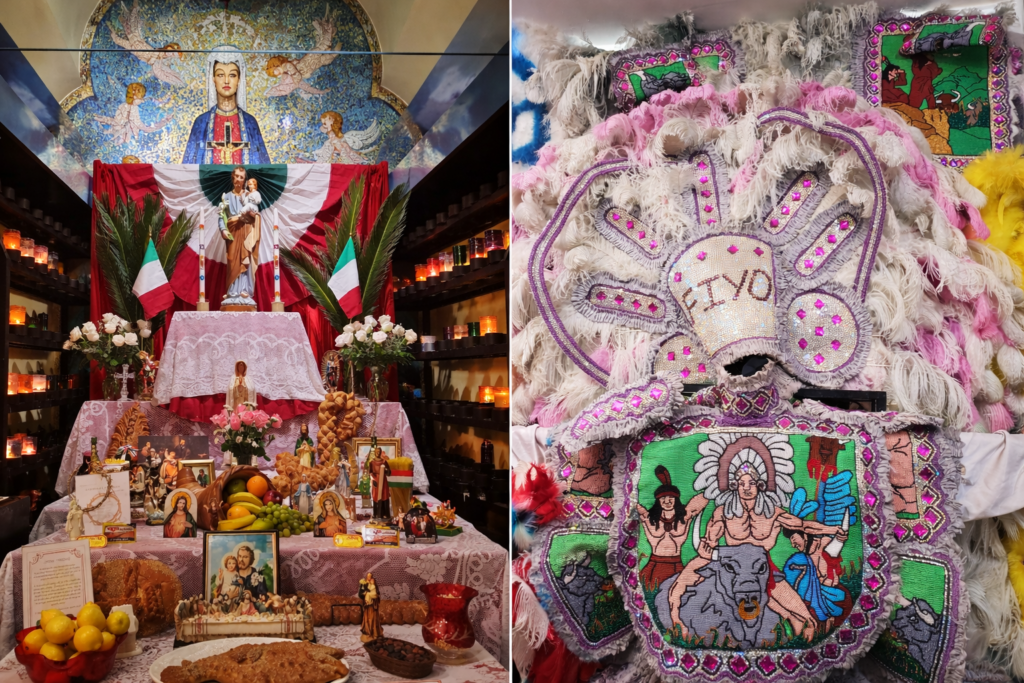
St. Joseph’s Altars & Masking Mardi Gras Indians
Every year on March 19th, something special happens in New Orleans.
It is a day where faith, culture, and community come together in ways that feel both sacred and celebratory. A day where tables overflow with food, streets come alive with movement and color, and traditions passed down through generations are brought forward once again.
But I’ll be honest.
This was not something I grew up with.
A Tradition I Found Later in Life
Growing up in North Louisiana, my Creole experience was rooted in church, family, and community, but the traditions of St. Joseph’s Day altars and Masking Mardi Gras Indians on St. Joseph’s Night were not part of my childhood.
It wasn’t until I moved to New Orleans that I encountered these traditions for the first time.
And when I did, something in me connected immediately.
Not because they were familiar, but because they felt like they belonged to me anyway.
The Beauty of St. Joseph’s Altars
St. Joseph’s Day is celebrated on March 19th in honor of St. Joseph, the patron saint of fathers, families, and workers.
The tradition of the altars was brought to Louisiana by Sicilian immigrants in the late 1800s, who prayed to St. Joseph during a devastating drought in Sicily. When their prayers were answered, they promised to honor him with elaborate altars filled with food and offerings.
That promise lives on today.
The altars are breathtaking.
Tables layered with, fresh breads and baked goods, fruits and vegetables, cookies shaped into religious symbols, intricate displays of devotion and gratitude.
But what makes them truly special is not just their beauty.
It’s the spirit behind them.
These altars are built to feed the community, to welcome strangers, and to give thanks. Homes and churches open their doors, inviting people in to share in the abundance.
It is faith in action.
Learning the Tradition Through Friendship
I didn’t find this tradition on my own.
It was shared with me.
My dear friend Opal Joyner introduced me to St. Joseph’s altars years ago. She took me from church to church, showing me the beauty of each altar, explaining the meaning behind the symbols, and eventually bringing me into private homes where families opened their doors to share their altars with others.
I remember being struck by how personal it felt.
How intentional.
How full of love.
And yes, she also taught me one of the more playful traditions of the altars.
Unmarried women could take a lemon from the altar, without being seen, and ask St. Joseph to help them find a husband.
Let’s just say…
I still have my lemons.
They’re over 15 years old now, completely mummified, and I’m still waiting on St. Joseph to come through. 😂
But even that small tradition speaks to something bigger:
Hope. Faith. Possibility.
St. Joseph’s Night & the Masking Mardi Gras Indians
As the sun sets on March 19th, another tradition comes alive.
Masking Mardi Gras Indians take to the streets.
This is not a performance.
This is culture in motion.
Dressed in incredibly elaborate, hand-sewn suits adorned with beads, feathers, and intricate designs, members of different tribes gather, chant, dance, and move through neighborhoods.
It is deeply rooted in African and Native American traditions, reflecting histories of resistance, resilience, and community.
The energy is electric.
The streets fill with, drum beats, chants, call-and-response songs, flashes of light illuminating suits in the night
It feels sacred.
It feels ancestral.
It feels alive.
A Culture That Lives at the Intersection
What struck me most as I experienced these traditions was how they came from different cultural roots, yet existed side by side. Sicilian Catholic devotion, African spiritual traditions, Native American influences.
And somehow, in New Orleans, they blended into something unique..
And that’s when it clicked for me.
As a Creole woman, with French, Spanish, African, Native, Italian, and Irish ancestry flowing through my veins, this was my culture too.
Not one piece.
All of it.
Creole culture has never been about fitting into one box.
It has always been about connection, blending, and becoming.
Carrying the Tradition Forward
Even now, years later, I still honor this tradition.
My friend Opal passed away in 2010, but every year on St. Joseph’s Day, I think of her.
And I bring a fava bean to her resting place.
In Sicilian tradition, fava beans are considered symbols of good luck, abundance, and survival, known for growing even in poor conditions.
To me, that symbolism runs deep.
Because that is who we are as a people.
We endure.
We adapt.
We grow, even in difficult conditions.
And we carry forward the traditions that were shared with us.
Why This Matters
St. Joseph’s Day and St. Joseph’s Night are more than traditions.
They are reminders.
That culture is meant to be shared.
That faith is meant to be lived.
That community is meant to be experienced.
And that we are not bound by, color, class, or circumstance.
We are connected by something deeper.
From Me to You ❤️
If you’ve never experienced a St. Joseph’s altar or seen the Mardi Gras Indians on St. Joseph’s Night, I encourage you to go.
Go with an open heart.
Go ready to learn.
Go ready to connect.
Because sometimes the traditions we didn’t grow up with…
are still part of who we are.
And sometimes all it takes is one person, like Opal was for me, to open that door.
A Moment to Reflect
What tradition have you discovered later in life that made you feel more connected to who you are?
Until next time, cousin,
take care of yourself, take care of your people, and keep living the Bella Creole Life.
With love and intention,
Cici
2026 St. Joseph Altars – Archdiocese of New Orleans – New Orleans, LA
Takin’ It To The Streets | WWOZ New Orleans 90.7 FM (St. Joseph Night Mardi Gras Indians)